


 Previous Article
Guide to Composite Fencing Colours: Trends, Pairings, and What to Expect
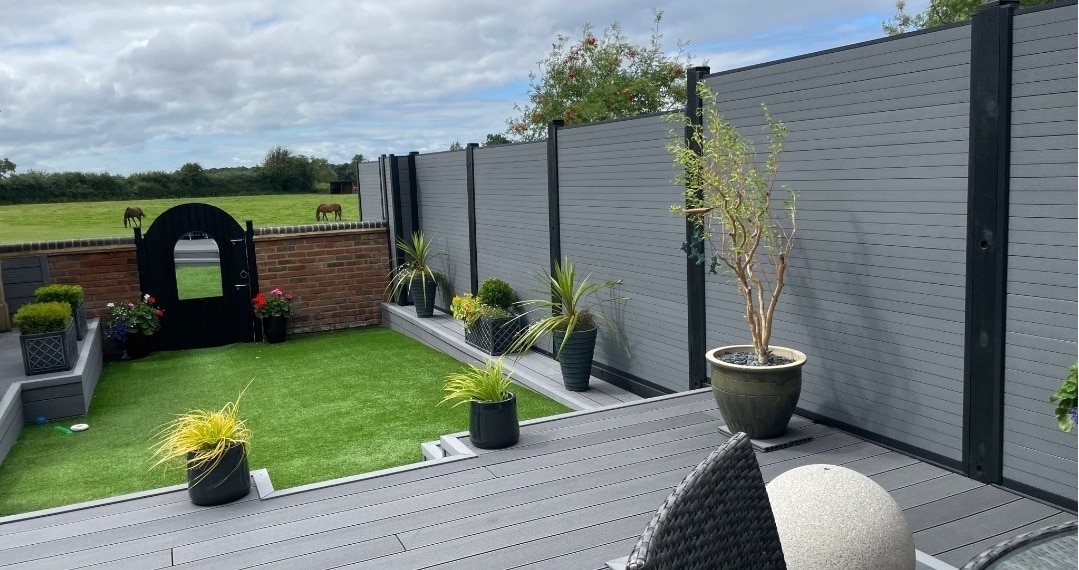
If you are researching materials to upgrade your fence panels, you will undoubtedly come across the term “fading” or “sun bleaching.”
As specialists in composite materials for almost a decade, we are often asked if composite fencing suffers from the same fading issues as decking. You need to be careful with cheap imitations claiming their composite boards will never fade under the sun. If a supplier tells you that, you should seriously question the integrity of their product.
The honest truth? The raw formula used to manufacture composite fencing is exactly the same as composite decking. Because the chemical makeup is identical, the ultimate fading percentages (the total amount of colour lost) remain the same. However, the rate and speed at which a fence fades is completely different. It all comes down to how the product is installed.
Almost all marketing and performance data regarding composite fading is heavily focused on the decking experience. But fences interact with the sun differently.
Outdoor composite decking boards are laid flat horizontally, meaning they absorb the brutal, direct midday sun for hours on end. Composite fence panels are installed vertically. Because of this upright orientation, the sun’s UV rays hit the boards at an angle, and usually only for a portion of the day before the sun moves over the house or boundary line.
Because fencing does not take the same direct UV hit as decking, the rate and speed of colour change is much slower and more consistent. Uncapped fencing boards will hold their initial colour for much longer before reaching their final weathered state, making the switch to composite fencing an incredible long-term performance investment.
Expert Note: The “Neighbour Effect” Because your fence is installed vertically, the angles at which the sun hits your side versus your neighbour’s side will likely be completely different. Do not panic if you notice a slight colour difference between the two sides of the fence during the first few months. This is a normal reaction to differing UV exposure and will eventually balance out.
First-generation composite fencing is made from a blend of recycled plastics and up to 60% real wood fibres to achieve a natural appearance. When exposed to the elements, this material will go through a natural weathering process.
While the speed is slower than decking, you can still expect the colour to lighten by up to 30% over its lifespan. This happens in two distinct stages:
Stage One: Extractive Bleeding
The first natural process is extractive bleeding. This occurs because natural wood oils (tannins) are present in the wood fibres. Rain and moisture gradually wash these oils out of the vertical boards. Lighter-coloured fences often go through the most noticeable changes, as more natural oils are used to achieve their specific tone.
Stage Two: UV Fading
The next stage is caused by the sun breaking down materials at an atomic level. High-quality first-generation fencing incorporates UV stabilisers during manufacturing to control this process, allowing the colour to eventually stabilise.
Our advice: Because uncapped boards will naturally lighten as they weather, it is worth considering how the initial shade may change before making your final choice. Exploring the various composite fencing colours helps you evaluate the different shades and pairings to ensure your chosen tone looks great both now and years down the line
If the idea of your fence losing some of its initial colour concerns you, you should look at second-generation composite fencing.
Second-generation capped fence panels feature an engineered protective outer layer wrapped around the composite core. This additional layer is designed to provide increased resistance to UV exposure, moisture, staining and colour change compared with uncapped composite boards.
Please note: High-quality capped fence will only lose an estimated 5% of its colour.
The Plastic Quality Matters
The quality of that protective shield dictates the performance. High-quality High-Density Polyethylene (HDPE) will retain its rich colour for decades. If a manufacturer uses cheaper Low-Density Polyethylene (LDPE) to cut costs, it will lead to an increased rate of colour change and potential structural issues.
Fading is only one part of how a fence changes once it is exposed to the elements. Dirt, organic matter and general weathering can also affect its appearance, so following the correct composite fencing cleaning and maintenance routine will help keep the boards looking their best.
Mother Nature is aggressive, but composite fencing is built to handle it. Due to its vertical installation, your fence will weather much slower than a deck, providing a beautiful, low-maintenance boundary for years.
If you choose standard uncapped boards, expect a gradual colour reduction of up to 30% as the natural wood fibres weather. If you want a strictly “fit and forget” solution with a locked-in colour that only loses around 5% over its lifespan, second-generation capped fencing made with premium HDPE is the ultimate choice.
 Previous Article
Guide to Composite Fencing Colours: Trends, Pairings, and What to Expect

Cleaning & Maintenance Composite Fencing: The Ultra Decking Guide
