


 Previous Article
What Material Should I Use for My Rooftop Decking?
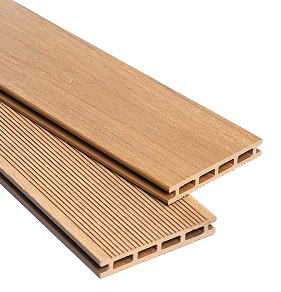
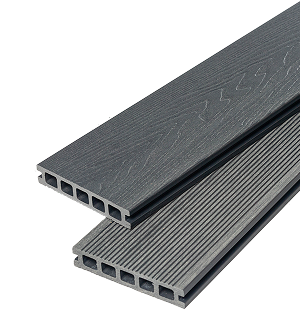
Is your old wooden deck looking tired, worn, or starting to rot? Whether it’s five or fifteen years old, all timber decking eventually succumbs to the UK weather.
Upgrading to composite decking is the ideal, long-term solution. It’s an eco-friendly material that offers superior performance in moisture, fade, and stain resistance.
But what about the underframe—can you reuse it? The short answer is yes, provided it is fully checked and structurally sound.
This guide will walk you through that critical decision, explaining what parts of your old deck, if any, can be safely reused.
This is the first question every homeowner asks when considering an upgrade. The answer depends entirely on the condition of your existing subframe. There are two very different scenarios you may encounter:
To avoid these problems, you must create a stable, level, base with sufficient drainage provided. Here are the two best methods: –
We are sometimes asked if new composite boards can be laid directly on top of an old timber deck to save time. Our expert advice is never to do this.
Your new composite decking requires adequate ventilation underneath the boards to prevent moisture build-up, which leads to mould and mildew. Laying boards directly on top of an old deck traps this moisture, creating a perfect breeding ground for rot and compromising the structural integrity of both the old and new deck. It is a “false economy” that will cause major problems down the line.
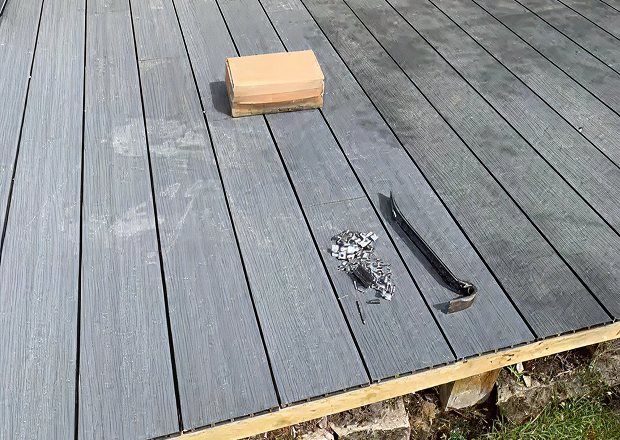

This is a much more realistic option, but only if your existing subframe is in excellent condition. Before you consider this, you must perform the following three-point inspection.
The Physical Test: Take a screwdriver and firmly probe the joists and posts in several places, especially near the ground or in damp areas. If the screwdriver sinks in easily or the wood feels soft and spongy, the timber is rotting and must be replaced. A sound frame will feel hard and solid.
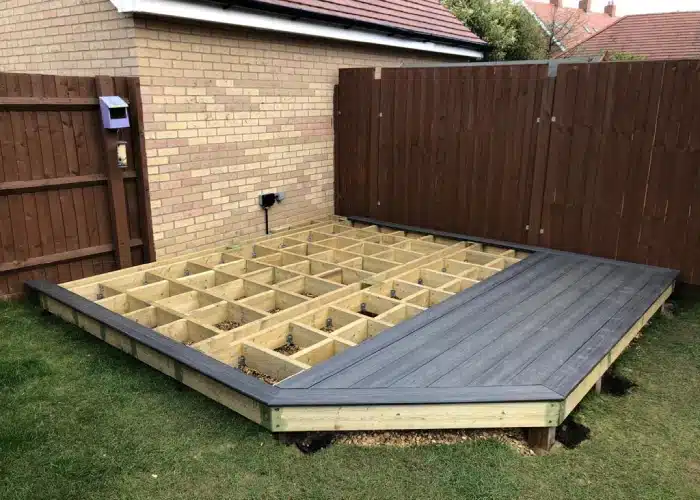
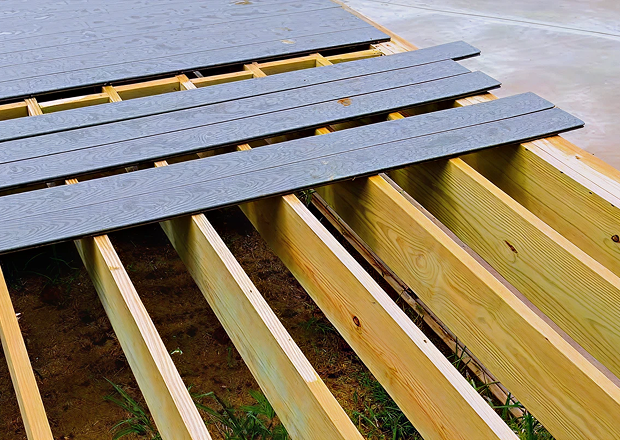
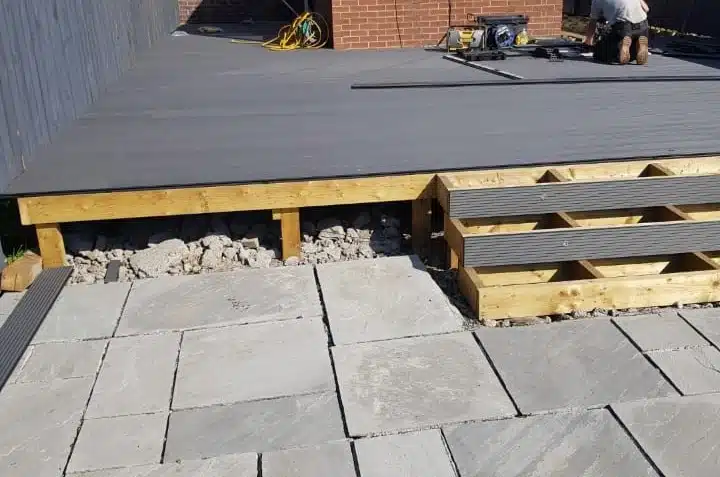
⚠️ A Note on Structural Load & Safety
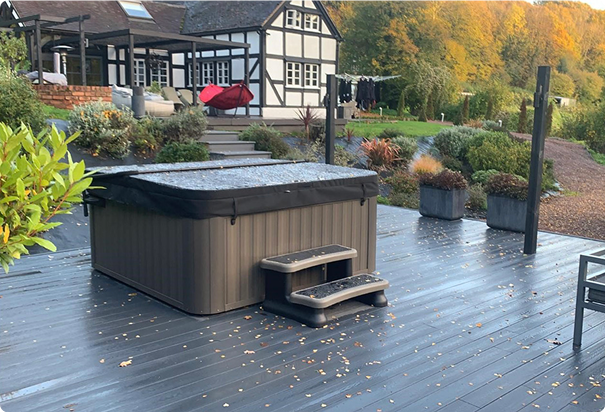
While your subframe may pass a rot test, composite decking is often heavier than softwood. If you plan to add heavy features—such as a hot tub, large planters, or a masonry fire pit—you must consult a structural engineer. Reusing an old subframe designed for lightweight timber may lead to structural failure under increased load. Safety first: when in doubt, reinforce.
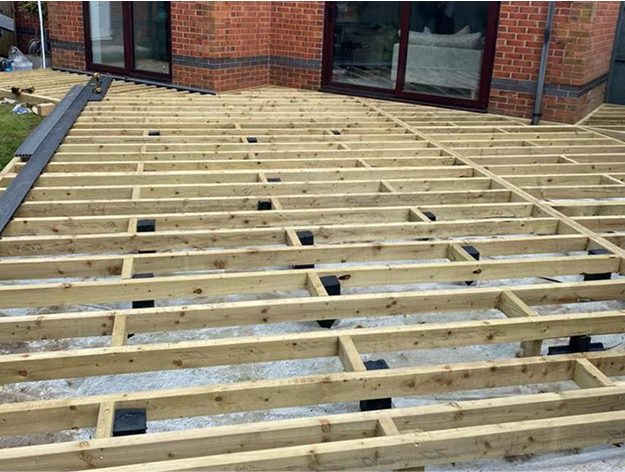
Even if your joists are solid, removing old wooden boards will leave thousands of open screw holes along the top of the timber.

Reusing a frame in poor condition is a “false economy.” However, if it passes inspection, the savings can be substantial. By reusing the structure, you could save £60+ per m² on labour and £24.15 per m² on materials—a potential saving of over £84.15 per m².
Note: Even with this saving, you must still budget for the key components:
No. Composite boards expand and contract differently than timber. You should always use the manufacturer-recommended hidden fastener clips or specific composite screws to avoid cracking the boards or voiding your warranty.
Yes. In the UK’s damp climate, the top of the joist is where water sits. Joist tape acts as a waterproof membrane, sealing the old screw holes and potentially adding 10+ years to the lifespan of a sound timber frame.
Measure from the middle of one joist to the middle of the next. If the distance is 400mm or more, you must add “noggins” or additional joists to provide the necessary support for composite decking.
Choosing to upgrade from wood to composite decking is an investment that pays for itself. While the upfront cost is higher, the savings on annual maintenance mean that composite often becomes the more cost-effective option within just 5–7 years.
A solid, correctly built, and properly protected subframe is essential to building decking. Do not cut corners on the subframe. It is the skeleton that guarantees longevity, peace of mind, and safety for decades to come. While reusing a subframe is possible if it passes a rigorous 3-point inspection, the ultimate solution for 2026 and beyond is a new composite deck on a new, correctly built subframe. This ensures a flawless finish and full warranty compliance.
 Previous Article
What Material Should I Use for My Rooftop Decking?

Cost Of Installing Composite Decking
