


 Previous Article
The Ultra Guide to Cladding Types
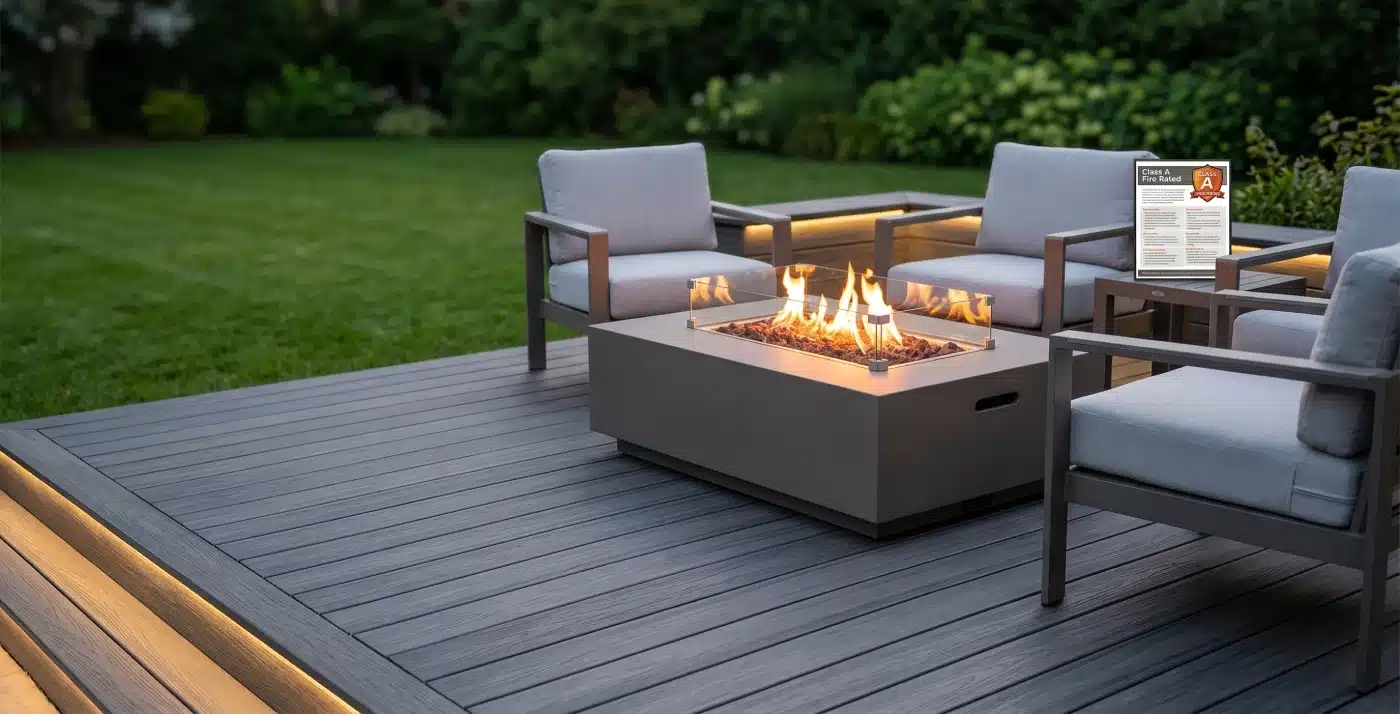
Over the last few years, changes to UK building regulations have caused a massive surge in questions regarding fire-resistant composite decking.
Yes, composite decking can be manufactured to be fire-resistant, but the critical question is: to what standard? In the UK and Europe, fire resistance must be proven via strict third-party testing to EN or BS standards.
If you are figuring out how to build the right decking for your project and suspect fire resistance is a requirement, you must check with your local authority, your architect, and your building insurance provider. To help cut through the confusing technical specifications, here is a simplified, straight-talking guide to composite decking fire ratings.
For 90% of domestic garden projects, you do not need to worry about specialized fire ratings. If your deck is at ground level in a standard back garden, standard domestic-grade composite decking is perfectly safe and compliant.
Fire resistance becomes a strict legal and safety requirement when your decking is elevated, attached to a high-rise building, or projecting out from a property (such as a balcony or roof terrace).
If you are adding decking to a building, the height of the project dictates exactly what materials you are legally allowed to use:
When you purchase premium composite decking online, you are almost always looking at “domestic grade” boards. Because 90% of garden projects do not require fire-rated boards, most domestic composite decking online or in-store is not fire-tested to commercial standards.
If your project requires even the slightest fire resistance, you must explicitly tell your supplier. This triggers them to discuss commercial-grade options with you.
If an online supplier claims their standard domestic board is heavily fire-resistant, ask for the testing documents. We speak from experience: a huge percentage of suppliers will not be able to produce them, which could cause massive legal and insurance issues for you down the line.
Manufacturers can produce composite boards that achieve a Class C or Class B fire rating, but it requires changing the chemical formula and adding specific fire-retardant properties during manufacturing.
Because of this, you need to budget for the following:
Furthermore, because these are specialist boards, they are not always kept in heavy stock. You may face longer lead times, so searching specifically for commercial construction suppliers might help you acquire the materials a little faster.
Once you find a supplier with the right fire-rated boards, you must get the physical documents and certificates to prove the rating. Do not just trust a badge on a website.
Why is this critical? In the future, if you decide to sell your property, or if your insurance company conducts a review, you will be required to show definitive proof that the balcony or roof terrace complies with building regulations. Get the paperwork beforehand.
While most standard domestic boards on the market offer zero fire resistance, we do things differently. Our standard composite decking has been on the market for almost a decade, and we believe in providing the highest standard of value and safety possible. That is why we include a small amount of fire retardant in our standard domestic formula.
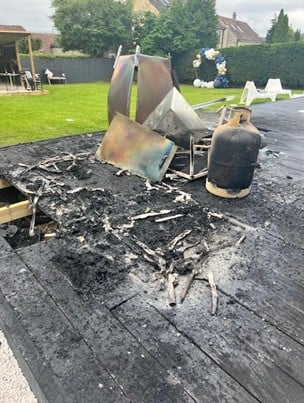
The value of this was proven during a customer’s family birthday house party. An outdoor burner was accidentally knocked over, setting alight the surface of the deck. The customer later reported that our composite decking essentially saved their home. The built-in retardant significantly slowed the burn rate down compared to what would have happened with traditional timber or cheaper composites.
After the event, a fire specialist confirmed that the quality of our composite decking stopped the fire from aggressively burning through and hitting the timber joists below, which would have set the entire structure alight.
Read the full survival story and see the aftermath photos of how our decking saved the family home here.
When it comes to fire safety, check your supplier’s years of expertise and their commitment to quality. If fire resistance is critical to your project:
Do your research upfront to save yourself from any nasty—and expensive—surprises later.
 Previous Article
The Ultra Guide to Cladding Types

Is Composite Decking Scratch Resistant? Which Is the Best?
